
The future of work, the future of business

COVID-19 presents a completely different future for the world of work.
But forces such as digitalisation were already changing the workforce long before the pandemic.
According to OECD research, 31% of jobs could be radically transformed by automation.
But elsewhere, specialist jobs are being created.
These broad trends mean that many organisations are already preparing for an accelerated future.
The infographic below, produced by PwC, identifies five priorities that can help lead the way in planning for the future of corporate work – reinforced by responses from an ongoing survey of US finance executives about their workforce strategy.
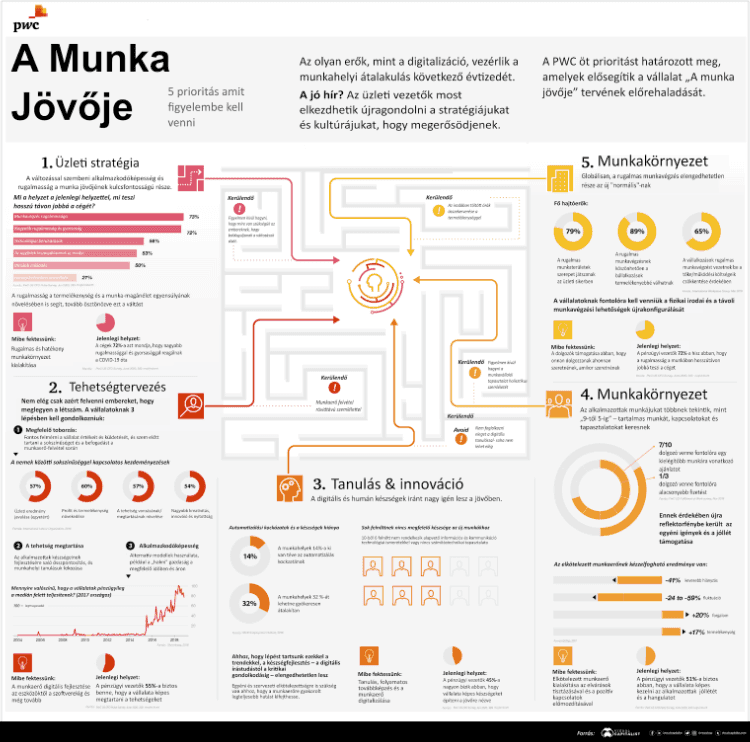
1. Business strategy
According to the survey, 72% of US CFOs believe that their response to COVID-19, improved flexibility and agility, will be a key factor in the long-term development of their company.
Flexible working, such as teleworking or shorter working weeks, can also help improve productivity and work-life balance, further driving this change.
Companies should not ignore the needs of employees and invest in creating a thriving working environment.
This trend can also be observed in Europe.
2. Talent planning
Recruitment alone is not enough to achieve the workforce objectives.
Companies need to think in three steps when building a strong talent pool:
We encourage businesses to assess their company’s values and mission, and to keep diversity and inclusion in mind when recruiting.
There is evidence, for example, that gender diversity initiatives are good for the bottom line, improve results, increase profits and productivity.
It is also important to retain talent!
Currently, 55% of CFOs are not very confident in their company’s ability to retain top talent.
Organisations should avoid hiring with a short-term mindset.
Instead, they should focus on developing the skills of their employees, with an emphasis on upskilling them on digital tools and software.
3. Learning and innovation
Despite incoming automation threats, six out of ten adults still lack basic information and communication skills.
The good news?
In the future, both digital and human skills will be in high demand.
Keeping up with these trends will require training ranging from digital literacy to critical thinking.
This requires both individual and organisational commitment to creating a culture of learning in the workforce.
Currently, only 45% of CFOs feel very confident that their company can develop the skills needed for the future.
4. Work experience
Today, workers rarely see their job as a “nine-to-five” job.
Instead, they seek meaningful work, connections and experiences.
PwC notes that one in three workers would be willing to consider a lower salary for a more fulfilling job.
This has brought a renewed focus on supporting individual needs and well-being.
An engaged workforce has tangible benefits:
- 41% reduction in absenteeism
- 24-59% less turnover
- 20% increase in turnover
- a 17% increase in productivity
For future success, organisations need to develop a holistic view of the employee experience.
To this end, 49% of finance leaders lack confidence in their company’s ability to manage employee wellbeing and morale.
5. Working environment
Flexible working is an essential part of the future of business and it seems to be taking root.
72% of finance executives believe that flexibility at work will make their companies better in the long term.
This highlights the urgent need to transform traditional offices and strengthen teleworking opportunities – allowing employees to work from where they want, when they want.
It is clear that the debate on the future of work is not taking place in a bubble – these alternative labour demands are simply accelerating the inevitable transition.
Many companies focus on just two or three of these priorities, but aligning all five will be key to the future of work.
Source: PwC, Visual capitalist